5 Signs Your Oak Tree Needs Professional Care (Before It’s Too Late)
Signs Your Oak Tree Needs Professional Care are often easy to miss until it’s too late. Oak trees are the backbone of Tuscaloosa landscapes—from the majestic Southern live oaks along Greensboro Avenue to the towering water oaks near University of Alabama homes. These trees define our community’s character but are vulnerable to diseases and stresses that can turn a healthy tree into a hazard. As ISA Certified Arborists with over 38 years of experience treating Tuscaloosa oaks, we know how to spot these warning signs early and help homeowners protect their trees.
Here are five critical indicators your oak needs professional attention—and what happens if you ignore them.
Summer Leaf Drop That’s Not Normal
What You See: Leaves falling in June, July, or August when they should be green and healthy.
What It Means: Oaks naturally shed some interior leaves during summer heat—this is normal. But if you’re seeing significant leaf drop (covering your lawn, noticeable thinning in the canopy), your tree is under severe stress.
Common Causes in Tuscaloosa:
- Hypoxylon Canker: This stress-related fungal disease is epidemic in Tuscaloosa during hot, dry summers. It attacks oaks weakened by drought, soil compaction, or root damage. The fungus colonizes sapwood, blocking water transport and causing sudden branch death. Early signs: Premature yellowing and leaf drop, bark sloughing off to reveal dusty gray-white fungal growth underneath, and branch dieback starting in the upper canopy.
- Oak Wilt: A devastating vascular disease that kills red oaks in 3-6 weeks and white oaks in 3-6 months. It spreads through root grafts between nearby oaks and through sap-feeding beetles attracted to fresh pruning cuts.
Early signs: Rapid leaf browning starting at leaf edges, leaves dropping while still partially green, and wilting that starts in upper branches and progresses downward.
What To Do: Don’t wait to see if the tree recovers on its own—it won’t. Call for a professional diagnosis immediately. We use soil testing, tissue sampling, and visual assessment to identify the exact problem. For Hypoxylon canker: Deep root fertilization, soil improvement, and stress reduction can save trees if caught early. Advanced cases require removal. For oak wilt: Immediate action is critical. We inject fungicides, install root barriers to prevent spread to nearby oaks, and in severe cases, remove infected trees before they infect neighbors.
Cost of Waiting: A $400 treatment program in early summer becomes a $2,500-4,000 removal by fall when the tree dies completely. We’ve watched this happen dozens of times to homeowners who thought their oak would “bounce back.
Fungal Growth at the Base or on the Trunk
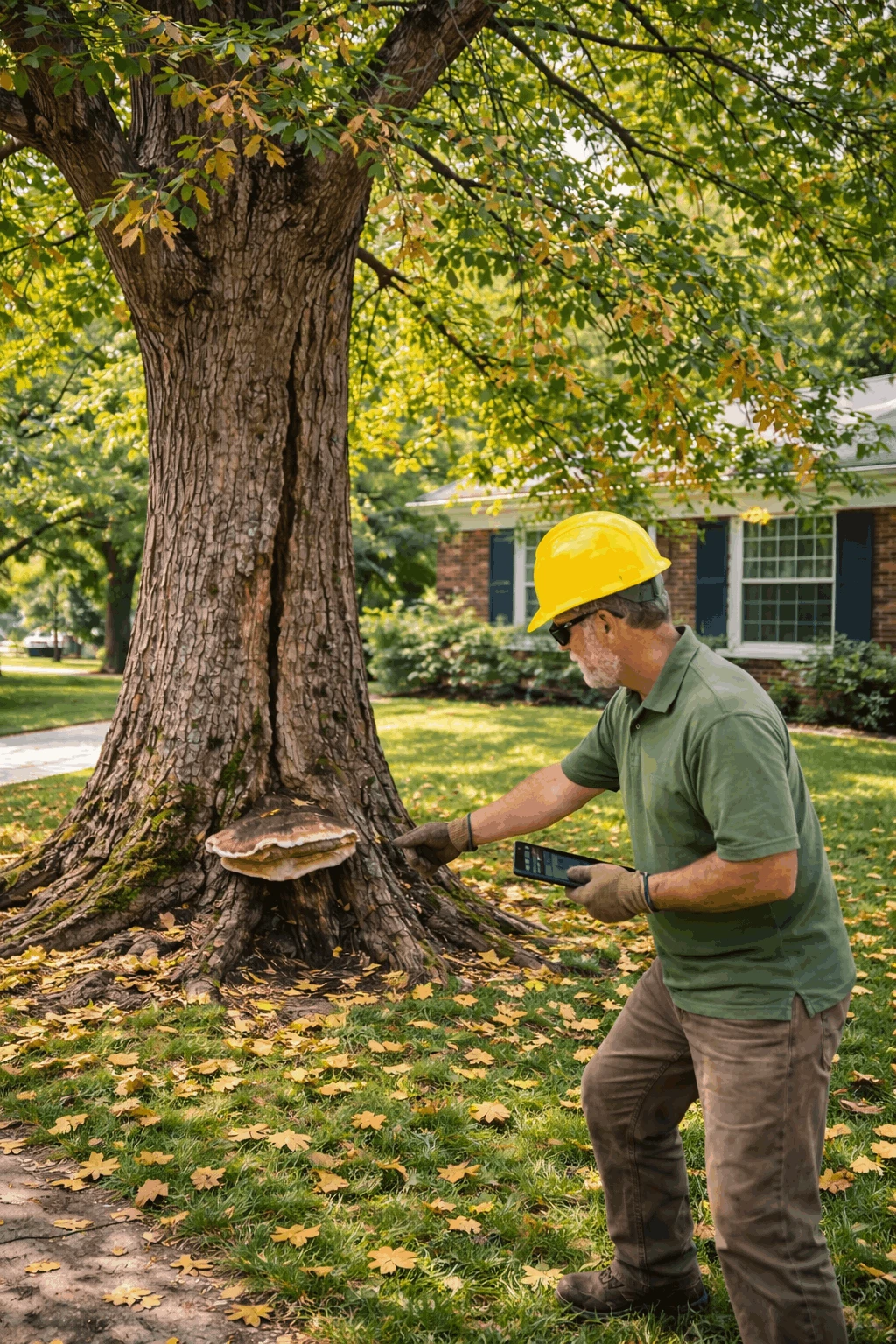
What You See: Mushrooms, shelf fungi, or crusty growths appearing at the trunk base or on major roots.
What It Means: Visible fungal fruiting bodies are like the tip of an iceberg—by the time you see them, extensive internal decay has already occurred. The fungi you see are just reproductive structures; the actual organism is inside the tree, consuming wood and creating hollow cavities.
Common Tuscaloosa Oak Fungi:
- Armillaria Root Rot (Oak Root Fungus): Produces honey-colored mushrooms at the base in fall. This fungus attacks roots and the lower trunk, creating white rot that destabilizes the entire tree.
- Ganoderma (Artist’s Conk): Creates large, shelf-like fruiting bodies. Indicates advanced heartwood decay—the tree’s structural core is rotting.
- Inonotus (Oak Heart Rot): Forms rough, crusty brackets on trunks and major limbs. Causes extensive internal decay while the tree looks healthy externally.
What To Do: This requires immediate professional assessment. We use: Sonic tomography: Sound waves map internal decay—we can literally “see” hollow areas inside the trunk. Resistance drilling: Measures wood density to identify rot pockets. Visual risk assessment: Determines if the tree is an immediate hazard
Treatment Options:
- Minor decay (less than 30% of trunk diameter): Monitor, reduce stress, possibly install support cables
- Moderate decay (30-50%): Cabling, pruning to reduce weight, close monitoring
- Severe decay (50%+): Usually requires removal—the tree can’t support its own weight
Real Example: In 2023, we assessed a 150-year-old water oak on Greensboro Avenue with Ganoderma fruiting bodies. Sonic testing revealed 60% of the trunk was hollow. The tree looked magnificent from the outside, but it was structurally unsound. We removed it before the next storm—three months later, another oak on the same street with identical symptoms fell during thunderstorm winds, crushing a car.
Vertical Cracks or Seams in the Bark
What You See: Long cracks running up and down the trunk, bark separating from the wood, or “seams” where bark sections are pulling apart.
What It Means: Internal structural failure is occurring. These cracks indicate:
- Frost damage from extreme temperature swings
- Internal decay is causing pressure
- Storm damage to internal wood fibers
- Natural aging and stress in older trees
Why It’s Dangerous: Vertical trunk cracks are failure points. During storms, trees often split along these cracks—sometimes the entire trunk splits in half. We’ve responded to dozens of emergencies where cracked oaks failed during high winds.
What To Do: Professional assessment within 2-4 weeks. Not all cracks require removal, but they all require evaluation.
Treatment depends on severity:
- Surface cracks (less than 1 inch deep): Monitor, possibly install flexible bracing
- Deep cracks (1-3 inches): Cable and brace systems, reduce canopy weight through pruning
- Full-depth cracks (through the trunk): Usually requires removal—the tree is structurally compromised
The Bradford Pear Comparison: Bradford pears are notorious for weak branch unions that crack and split. Oaks with vertical cracks have similar failure risks. The question isn’t if they’ll fail—it’s when.
Root Damage or Exposure
What You See: Roots exposed above ground, soil erosion around the base, roots cut or damaged by construction, or fungal growth on visible roots.
What It Means: Your oak’s foundation is compromised. Trees need extensive root systems—typically extending 2-3 times the width of the canopy—to stay upright and absorb water. Damage to these roots creates:
- Instability (a tree can topple during storms)
- Water stress (can’t absorb enough moisture)
- Nutrient deficiency (can’t access soil nutrients)
- Disease vulnerability (damaged roots invite rot fungi)
Common Causes in Tuscaloosa:
- Construction Damage: Building additions, driveway installations, and utility trenching frequently sever major roots. Even driving heavy equipment over root zones compacts soil and suffocates roots.
- Soil Erosion: Tuscaloosa’s clay soils are prone to erosion during heavy rains, exposing roots that should be underground.
- Root Rot: Phytophthora and Armillaria fungi thrive in Tuscaloosa’s poorly-drained clay soils, attacking roots and causing decay.
What To Do: Root damage assessment should happen immediately—especially if construction occurred within the past 6 months. We evaluate: Percentage of root system damaged (30%+ root loss is critical), Location of damage (roots on the prevailing wind side are most critical for stability), Signs of active decay or disease, Soil drainage and compaction issues
Treatment Options:
- Root pruning and wound treatment
- Soil improvement and drainage correction.
- Deep root fertilization to stimulate new root growth
- removal before the tree becomes unstable
Real Cost: A $300 root assessment and $500 treatment program can save a valuable oak. Ignoring root damage often leads to tree failure—we’ve seen 80-foot oaks topple onto homes because construction damage went untreated.
Unexplained Branch Dieback
What You See: Individual branches dying while the rest of the tree looks healthy, progressive dieback starting in the upper canopy and moving downward, or random dead branches scattered throughout the crown.
What It Means: Something is attacking your tree’s vascular system—the “plumbing” that moves water and nutrients.
Branch dieback patterns tell us what’s wrong:
- Top-down dieback: Usually indicates root problems, drought stress, or vascular diseases
- Random scattered dieback: Often means boring insects or localized decay
- One-sided dieback: Can indicate root damage on that side or soil issues
Common Tuscaloosa Causes:
- Oak Wilt: Progressive branch death, usually starting in the upper canopy
- Hypoxylon Canker: Random branch death during stress periods
- Boring Insects: Scattered branch death with visible holes or sawdust
- Root Disease: Gradual decline with increasing branch death over months
What To Do: Branch dieback requires diagnosis—don’t just prune out dead branches and hope for the best.
Our diagnostic process:
- Tissue sampling of affected branches
- Root excavation and inspection
- Soil testing for pathogens and pH
- Insect inspection (we often find boring beetles)
Treatment depends on diagnosis: Vascular diseases:
- Fungicide injections, stress reduction
- Insect infestations: Targeted insecticide applications, Root problems
- Soil improvement, drainage correction, and advanced decline:
- Often requires removal
The 30% Rule: If more than 30% of the canopy is dead, recovery is unlikely even with treatment. At that point, removal is usually the safer option.
When To Call a Professional
You don’t need to panic at every fallen leaf or minor issue. But these situations require professional assessment:
✓ Any of the five signs above
✓ Sudden changes in tree appearance
✓ Recent construction near the tree
✓ Storm damage (even if the tree looks okay)
✓ Visible fungal growth anywhere on the tree
✓ Trees near structures, power lines, or high-traffic areas
✓ Historic or valuable trees showing any decline
What Professional Assessment Actually Includes
When you call us for an oak assessment, here’s what happens:
On-Site Evaluation (30-45 minutes):
- Complete visual inspection from roots to crown
- Crown density and dieback assessment
- Trunk inspection for cracks, cavities, and fungal growth
- Root collar excavation to check for buried stem and root health
- Soil assessment for drainage and compaction
Testing (if needed):
- Soil sampling for pH and pathogen testing
- Tissue sampling for disease diagnosis
- Sonic tomography for internal decay detection
- Resistance drilling for cavity measurement
Written Report:
- Diagnosis of specific problems, Treatment recommendations with costs
- Timeline for treatment or removal
- Risk assessment (Is the tree currently dangerous?)
- Cost: $100-150 for a comprehensive assessment, waived if you proceed with recommended treatment over $500.
The Value of Saving vs. Removing
Many homeowners assume every sick oak needs removal. Not true. We’ve saved hundreds of valuable oaks through proper diagnosis and treatment.
When to treat: Less than 30% canopy decline
- Treatable diseases (caught early)
- High-value or historic trees
- Structural issues that respond to cabling
When to remove: More than 50% canopy death,
- Advanced internal decay
- Untreatable diseases (late-stage oak wilt),
- Immediate safety hazards
Cost Comparison:
- Treatment program (3 years): $1,200-2,000
- Removal and replacement: $2,500-5,000+
- Plus: You lose 50+ years of growth and thousands in property value
Take Action Today. Oak decline happens gradually, then suddenly. That tree that “seemed fine last year” can fail catastrophically during this year’s storm season. Free oak assessment with any service estimate. Call us today: (205) XXX-XXXX Our ISA Certified Arborists will assess your oaks honestly. If they’re healthy, we’ll tell you. If they’re in trouble, we’ll explain exactly what’s wrong and what it will take to save them—or why removal is safer. Your oaks are worth protecting. Let’s make sure they’re still standing for the next generation. More Tree Care Articles: Understanding Tuscaloosa’s Clay Soil and Your Trees When to Remove vs. Save a Storm-Damaged Tree The Truth About Topping Trees (And Why You Should Never Do It) Best Trees to Plant in Tuscaloosa (And Which to Avoid) Questions? Contact us at (205) XXX-XXXX or service@[yourcompany].com
Take Action Today
Oak decline happens gradually, then suddenly. That tree that “seemed fine last year” can fail catastrophically during this year’s storm season.
Free oak assessment with any service estimate.
Call us today: (205) XXX-XXXX
Our ISA Certified Arborists will assess your oaks honestly. If they’re healthy, we’ll tell you. If they’re in trouble, we’ll explain exactly what’s wrong and what it will take to save them—or why removal is safer.
Your oaks are worth protecting. Let’s make sure they’re still standing for the next generation.